Vol. XLII, No. 2Wednesday, April 8, 2026Price: One Good Laugh
*** Arts & Culture Desk ***
CSO Mark Smither Delivers Stirring Sermon on the Gospel of Springsteen
In an unscheduled cultural address, Paulsen's Chief Strategy Officer makes the case for Born to Run — and for never waiting to see your heroes live
SIOUX FALLS — Paulsen Chief Strategy Officer Mark Smither stepped away from market
positioning and audience analytics this week to deliver what witnesses are calling "a deeply
personal, occasionally tearful, and frankly unstoppable" presentation on the 1975 Bruce
Springsteen record Born to Run, an album he declared to be, quite simply, one of
the greatest ever made.
"American music doesn't know where it's at," Smither told the assembled crowd, setting the
scene. "It's post-'69. It's post-Woodstock. That baby boomer generation…" He paused to let
the weight of 1975 settle over the conference room. "You can listen to the top forty in
1975, and it's all over the place."
Into that cultural vacuum, Smither explained, walked a young New Jersey songwriter on his
third and likely final chance. "Prior to that, he had two albums that really didn't do very
well," he said. "The record company was gonna drop him if he doesn't come up with something.
So Bruce Springsteen channels his experience living in New Jersey and creates this sort of
epic musical cinema."
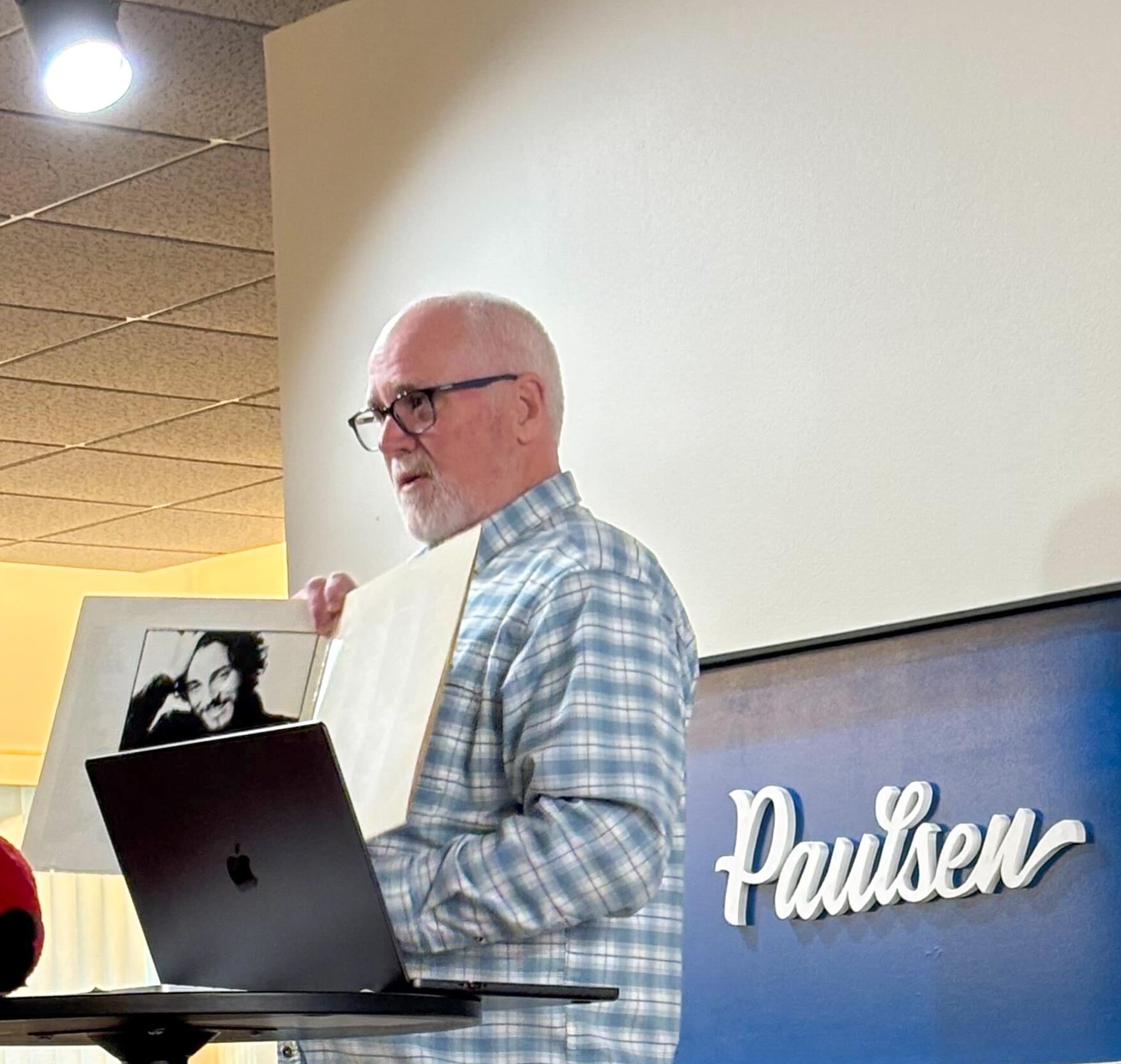
Chief Strategy Officer Mark Smither holds court. "He writes his own songs. He writes his
own lyrics," Smither said of Springsteen, visibly moved.
A Thirteen-Year-Old in Rapid City
At the heart of Smither's remarks was a story about himself as a boy: thirteen years old,
living in Rapid City, South Dakota, and thoroughly unmoved by the radio. "Trying to figure
out what I really like in life, and nothing really appealed to me," he recalled. Then came
the album.
"It didn't sound like anything else on the radio. It didn't sound like anything before,
and it hasn't sounded like anything since," Smither said. "It's got a little bit of rock
'n' roll. It's got Detroit. It's got Motown. It's got Clarence Clemons playing the
saxophone, which is incredible."
More than the sound, he said, it was the words. "I opened up this album, and all the
lyrics are in there. I'm reading these lyrics like this is a poet that's trying to tell me
something." Smither paused, and then delivered what several Paulsen employees described as
the line of the afternoon: "The reason I'm a writer today is [because] I opened up this
album."
"Who Do I Wanna Be?"
Asked what Born to Run was really about, Smither offered a reading that
would not be out of place in a graduate seminar. "It just reflected what was going on in a lot
of people's lives," he said. "They felt like there needed to be something bigger. They wanted
to break out. They didn't trust institutions. They kind of had to rely on their own selves."
"If you're a young person, thirteen, fourteen years old," he continued, "you just don't know
where you belong, and you don't know where you fit in. Until you hear something, or see
something, or experience something that says, I get this. This appeals to me, and I want to learn more about it — that's what this did for me."
Smither described the album as a single sustained work rather than a collection of songs. "A
lot of people don't listen to music in albums these days, and you have to listen to the whole
thing," he said. "It takes you from the beginning all the way to the end. You're on a sort of
a ride, if you will." The best song, in his estimation? "Born to Run."
As evidence of his commitment, Smither disclosed that he personally owns three copies of the
record — one at home, one at the office, and a spare. He does not, he confirmed, own a
turntable. "Just in case I lose one," he explained.
The $30 Regret
The address took an emotional turn when Smither recounted the great missed opportunity of his
young life. The year was 1984. Born in the USA had just dropped. Smither, by his own admission,
was "busted ass broke" and had just gotten back from an Elton John show in Lincoln, Nebraska, when
his friends announced they were heading right back to Lincoln to see The Boss.
"I go, 'Goddamn, the tickets are like $30,'" he recalled. "'I don't know if I'm gonna be able
to make this, guys.'" He passed. He told himself he'd catch Springsteen next time. Next time
took almost thirty years.
It wasn't until the Wrecking Ball Tour, in Minneapolis, that Smither finally saw Springsteen
live. He does not appear to have fully recovered. "I cried at that concert. It was so moving.
I'm literally weeping," he admitted. "I don't think my wife really appreciated that. But I'm
crying my eyes out because it was an entire lifetime, and everybody around me was doing the
same."
From this, Smither extracted a moral for any younger Paulsen staffers in the room: "If you
need to beg, borrow, or steal money to go see your favorite artist when you're young, I would
advise doing it. Don't wait."
On Becoming a Rock Star (in Client Services)
Smither noted that his love of Springsteen is not purely personal — it has, on at least
one occasion, been monetized. Asked whether he had ever deployed The Boss in a client
presentation, he confirmed that he had. "We had to do one for SDSU Extension," he said.
"We had to talk about how to be a rock star. So I used Bruce Springsteen as my metaphor
throughout his entire career of how you can be a rock star."
The Paulsen team, he admitted, had walked in expecting "just a bunch of old people,
really," and found instead a room of much younger attendees — a twist he delivered with
the timing of a man who has given many presentations in his life.
Before concluding, Smither also took the opportunity to remind employees of an unorthodox
performance management system he maintains privately. "Each of you are on a mental ladder
in my head," he warned the assembled staff. "And you rise and fall, like, every day, like
stocks." He declined to share current standings.
Smither pictured mid-metaphor. Sources confirm he owns three copies of Born to Run and zero turntables.
At press time, no fewer than four Paulsen employees were seen quietly adding Born to Run to their streaming queues. Whether any of them will begin smoking cigarettes,
as a young Smither reportedly wanted to do upon first hearing the record's closing track, is a development
this paper will continue to monitor.